
Summary
The historical narrative of Katugahagalge Rajamaha Viharaya in the Buttala region begins with a cave inscription by a donor named Vidisa, dating to the reign of King Devanampiyatissa in the 3rd century BCE. Folklore holds that the temple was built by King Walagamba during his time gathering an army in Ruhuna after losing his throne in the 1st century BCE. The tale of Therapuththabhaya Thero, one of King Dutugemunu's ten giant warriors, who later returned to this sacred site after the unification of Lanka, remains immortal in local legend. A rare stone pillar belonging to the 'Nissanka Gavu' distance-measuring system, established by King Nissanka Malla of the Polonnaruwa kingdom in the 12th century CE, has also been discovered on the temple grounds. Through two ancient stupas from the Anuradhapura era and an unbroken lineage of monks spanning over 2,300 years, this site stands as a living witness to Sri Lankan Buddhism and civilisation.
At a Glance
3rd Century BCE – Early Anuradhapura Period
Origins and Ancient Cave Inscriptions
The written evidence of Katugahagalge Viharaya's history stretches back to the 3rd century BCE. According to a cave inscription recently discovered by the Department of Archaeology, a person named Vidisa offered these caves to the monks. Historians have dated the script to the reign of King Devanampiyatissa (307-267 BCE). This makes it clear that the site has served as a dwelling for monks since the very inception of officially established Buddhism in the island.
"This cave was donated by a person named Vidisa"
Subsequently, evidence points to restoration work being carried out during the reigns of King Dutugemunu (161-137 BCE) and King Walagamba (103-77 BCE). Thus, it is accepted that for nearly 2,300 years, these caves have served as a continuous residence for Arahant monks, hermit monks, and an unbroken monastic lineage.
103 BCE – 89-77 BCE – Anuradhapura Period
King Walagamba's Era and Folklore
One of the most compelling folklore traditions associated with Katugahagalge Viharaya is its connection to King Walagamba (Vattagamani Abhaya). After the Anuradhapura kingdom fell to Sōli invaders in 104 BCE, the king was forced into hiding. According to local belief, during the period he was secretly building a new army from Ruhuna, he had this massive cave complex constructed as a dwelling for monks.
The temple's main cave measures approximately 300 feet in length and about 50 feet in width. This vastness allowed for the construction of both the image house and the monastic residence under a single rock cave. Fulfilling both needs under one cave roof is regarded as a rare feature among Sri Lankan temples.
161 BCE – 137 BCE – Anuradhapura Period
Therapuththabhaya Thero and the Gotaimbara Legend
A fascinating tale linked to Katugahagalge is connected with King Dutugemunu's ten giant warriors. Therapuththabhaya, one of those ten, is said in folklore to have been a novice monk at this very temple before the war. The folk story also tells of another giant named Gotaimbara, who became intoxicated after drinking seven pots of toddy at the nearby village of Muthukeliyawa and came to the temple grounds, causing disturbance and breaking the peace.
As the chief incumbent was away, the senior novice Therapuththabhaya ordered the troublemaker to leave. When Gotaimbara refused and continued his commotion, an angered Therapuththabhaya is said to have gripped Gotaimbara's toes with his own, dragged him to the edge of the rock outcrop, and flung him off. The event is remarkable for Therapuththabhaya's display of such extraordinary strength while being a layman.
Having witnessed this, King Kavantissa invited Therapuththabhaya to join his army. He accepted on the condition that he be allowed to return to meditation and monastic life after defeating King Elara and restoring sovereignty to the country. The cave where Therapuththabhaya resided is situated about 30 feet above ground level. Only a few small steps have been cut into the rock to access it, and today, a bamboo ladder is used to reach the cave.
Anuradhapura Period
Anuradhapura Stupas and Continuous Habitation
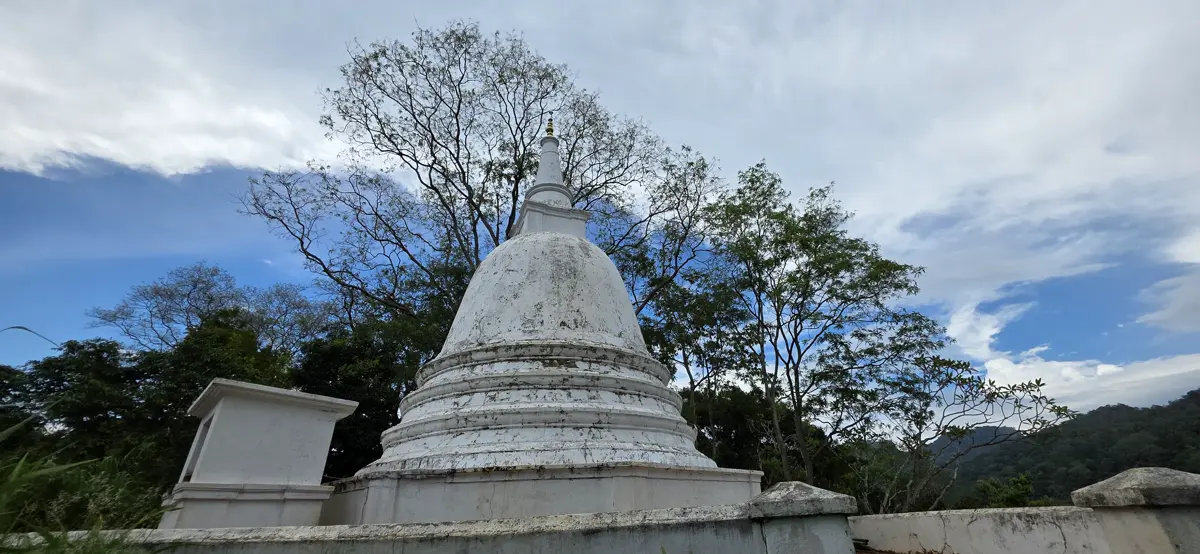
Atop a rock outcrop about 200 feet high near the temple lie the ruins of two ancient stupas. These are believed to date back to the Anuradhapura period. Over time, both stupas had eroded into a mound-like state, and unfortunately, a new stupa has been built over one of them in recent times. Another cluster of caves is found nearby, close to the Medalanda Eco Resort grounds, and evidence of underground tunnels, which requires further archaeological investigation, also exists at the site.
1187 – 1196 – Polonnaruwa Period
The Nissanka Malla Royal Pillar Inscription (Gavu Kanuwa)
This stone pillar inscription stands as a key testament to the significance of Katugahagalge Viharaya during the Polonnaruwa period. It is a 'Gavu Kanuwa'—a milestone belonging to the distance-measuring system known as 'Nissanka Gavu,' established by King Nissanka Malla, who ruled the Polonnaruwa kingdom from 1187-1196 CE. Of Kalinga origin (present-day Odisha, India), this king carried immense self-pride and ensured his name was inscribed on every monument he built or restored.
"Nissanka Gavui"
The 'Gavuwa' introduced by King Nissanka Malla is a unit of distance measurement, approximately equal to 4 miles (6.5 kilometres). Fearing a rebellion from the distant Ruhuna region due to his Kalinga origins, the king erected stone pillars at every Nissanka Gavuwa from Polonnaruwa to Ambalantota, inscribing cautionary messages to the people of Ruhuna.
Discovered in a nearby chena cultivation in 1880 and brought to the temple premises, this pillar bears those admonitions.
"People of Ruhuna, do not subject yourselves to the humiliating remarks of the Maya Rata folk. Do not crave the possessions of others. Refrain from excessive pride."
In addition, the inscription records details of two diplomatic missions sent to the Pandya kingdom bearing Thulabhara gifts (offerings equal to one's own weight) and returning with concubines, elephants, horses, and gifts from the Chola kingdom. It also mentions a tour through the three kingdoms (Ruhuna, Maya, and Pihiti) via difficult and rocky passages such as the Samanala mountain. A distinctive feature is that all Nissanka Gavu inscriptions end with the words 'Nissanka Gavui.'
Recent Times
The Modern Era: Damages, Restoration, and Current Status
In the recent past, Katugahagalge Viharaya fell victim to destructive acts by treasure hunters. Although the reclining Buddha statue was severely damaged as a result, it was successfully restored and its sanctity reinstated through the intervention of relevant authorities and the leadership of Chief Incumbent Ven. Mapakada Pemarathana Thero. Another change during this period was the construction of a new stupa over one of the two ancient Anuradhapura-era stupas on the rock outcrop.
Furthermore, as the old Dhamma hall of the temple was at risk of collapse, the need arose to construct a new Dhamma hall. Under the guidance of Chief Incumbent Ven. Mapakada Pemarathana Thero, and with the generous support of donors and villagers, construction work began a few years ago and has been successfully completed. The remaining archaeological ruins and underground tunnels on the temple grounds still await further exploration.